CAFE TEHRAN · FOOD STORIES
A rich, slow-cooked Persian stew made with aromatic herbs, tender meat and beans, Ghormeh Sabzi is a bowl full of family memories and a food story that moves across regional kitchens — from the Caspian coast to Kabul.
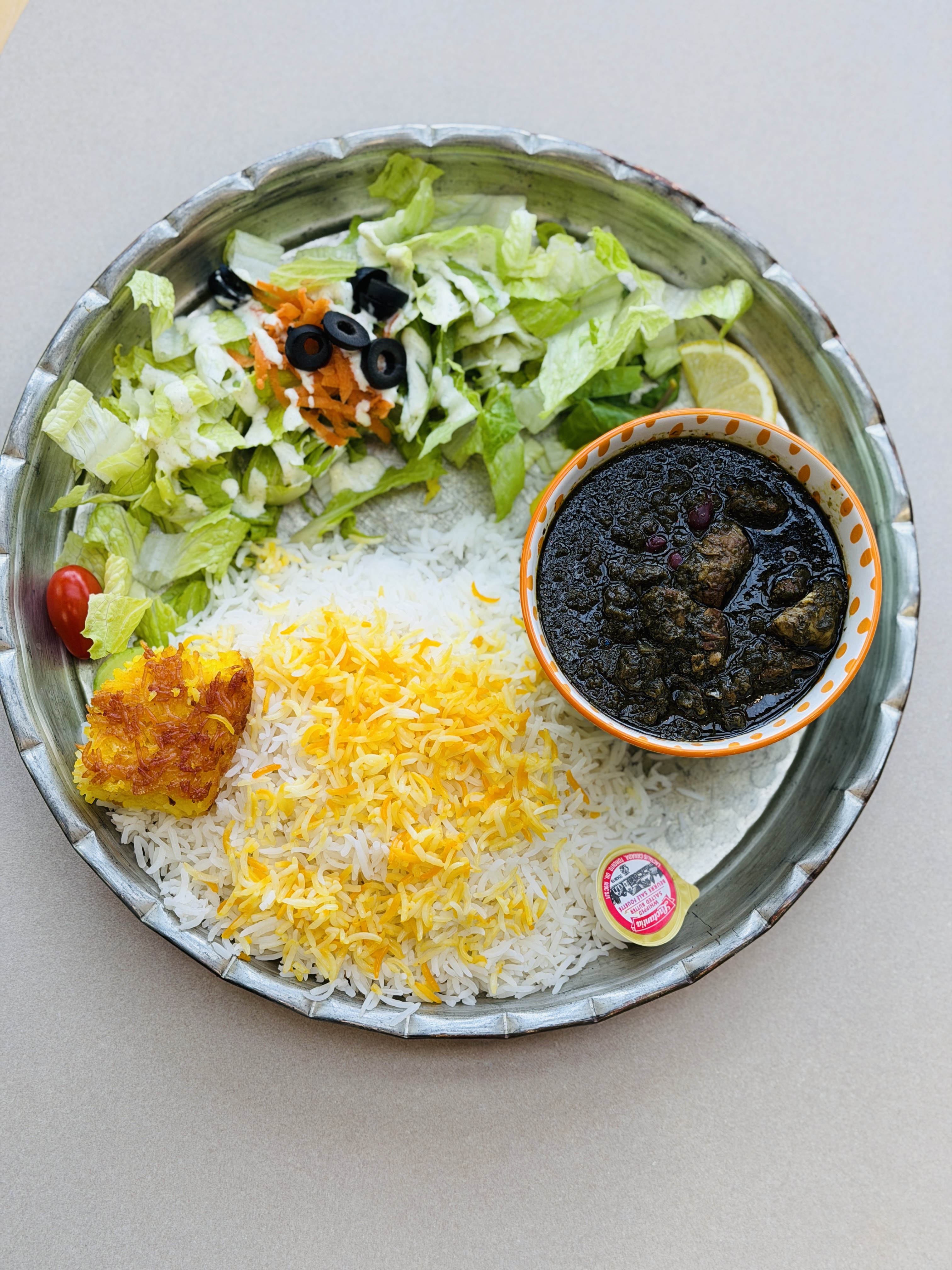
More than a stew: a taste of home
Ask an Iranian what food tastes like home and Ghormeh Sabzi is likely to come up. Its aroma begins long before the first spoonful: chopped herbs are patiently cooked, meat and beans soften in the pot, and the finished khoresh is brought to the table beside Persian rice. For many families, the recipe is remembered as much through the person who cooked it as through the ingredients themselves.
An entry on Ghormeh Sabzi by researcher Mohsen Ebrahimi in volume seven of the Persian-language Encyclopaedia of Iranian Folk Culture notes that there is no precise record of the dish’s earliest preparation or spread. The excerpt says some historical evidence points to its popularity among upper-class households during the Qajar period, before it became more widely enjoyed. It also records the stew in different food customs: Ashura meals in Sirjan, Mawlid celebrations in Sanandaj, and the Esbandi winter festival in some villages around Kashan. These accounts show how a beloved dish became part of different local gatherings; they do not establish one single birthplace for it. Read the reproduced Persian excerpt and the publication note for volume seven.
That is why it is better not to repeat claims that the modern recipe is thousands of years old or that it began in one specific province. The documented story is richer: families and regions have made the stew their own, while keeping its familiar identity.
Regional kitchens: related flavours, different dishes
A regional comparison should not turn every herb stew into “another Ghormeh Sabzi.” The Persian-language sources below document local dishes, ingredients and food customs. Some are close culinary relatives; others show the distinctive food traditions surrounding the stew. Where a source does not establish a separate Ghormeh Sabzi recipe, we say so rather than invent one.
Gilan: a fish-and-herb cousin called Kapour Ab
Gilan's cooking is known for its variety of herbs and intensely regional flavours. The Persian-language Visit Iran guide to lesser-known Gilaki foods notes the use of aromatic herbs such as chochagh and khalwash. It also describes Kapour Ab, a local carp-and-herb stew made with these greens, sautéed with the herb mixture used in Ghormeh Sabzi, then finished with garlic and sour grape juice. The source says it is similar to Ghormeh Sabzi, except that fish replaces the meat. This is a documented Gilan comparison — not simply a guessed “Gilan version” of the Persian stew.
Mazandaran: a food culture shaped by local produce
Mazandaran has its own distinctive table. A Persian-language regional overview from Anthropology and Culture records foods such as Aghouz Mesma with walnut and sour pomegranate, Torsh Torsho with sour plum, and Espenasak with spinach and pomegranate. A journal study in Farhang va Adabiyat-e Aammeh, based on ethnographic observation and interviews in several Mazandaran towns and villages, studies the relationship between food, language, local knowledge and social customs. These sources help explain the region's close connection with seasonal produce and distinctive sour flavours. They do not prove one standard Mazandarani Ghormeh Sabzi recipe.
Kurdistan: distinct local stews and seasonal greens
Persian reporting on Kurdish food traditions documents a varied local repertoire, including Ash Ghorreh, Ash Kashk, Tarkhineh, Rhubarb Stew and dishes made with mountain vegetables. A Tasnim overview of foods in Kurdistan lists several of these regional dishes, while another Persian report describes the use of wild spring greens in stews and other local preparations. These records show a strong local relationship with herbs and seasonal plants. They do not establish one exclusive or standardised Kurdish Ghormeh Sabzi recipe.
Lorestan: hearty dishes with their own names
Lorestan's food traditions include celebratory meat dishes and distinctive local stews and soups. A Persian report by Tasnim on traditional Lur foods records Shami Koo from Khorramabad, prepared with minced meat, herbs, walnuts and pomegranate paste, as well as Kallieh Torsh, Tarkhineh and Shole Mash. The report quotes a cultural-heritage anthropologist on local food traditions. These foods offer a better window into Luri culinary identity than an unsupported claim that there is one fixed Luri version of Ghormeh Sabzi.
Afghanistan: sabzi-challow at the Nowruz table
Across the border, Persian- and Dari-language sources document a close festive connection with green dishes and the New Year. In his book Nowruz and Its Status Among the Aryan Nations, Afghan writer Mohammad Azam Sistani describes sabzi-challow — identified in the passage with Ghormeh Sabzi — alongside fish as a customary Nowruz-night meal in old Kabul. The passage connects the green food with ideas of renewal and life. A separate Afghan cultural account describes families preparing rice with greens and, where possible, meatballs for the New Year table. These sources document an Afghan food tradition and a close cultural connection across the Persian-speaking region; they do not mean every Afghan household follows the same recipe.
Turkey and the wider neighbourhood: a careful comparison
Persian and Turkish food cultures share a long history of regional exchange, and both have many herb- and meat-based stews. However, the Persian-language sources reviewed for this article do not establish a standard Turkish dish identical to Iranian Ghormeh Sabzi. Without a reliable, specific source, it is better not to label a Turkish stew as a Turkish version of this dish. The comparison is interesting, but the distinction deserves to remain clear.
What makes the Persian classic recognisable?
Across many Iranian family recipes, the familiar character comes from cooked herbs, tender meat, beans and a carefully balanced depth of flavour. Dried lime is common in many versions and brings a distinctive tart note, although the exact herb mix, bean and souring ingredient can change between households. The dish is usually enjoyed with steamed rice — and for many people, the contrast between the khoresh and a crisp layer of tahdig is part of the pleasure.
The point is not to decide which province makes the one “correct” pot. It is to see how a much-loved dish can hold a common identity while reflecting the produce, tastes and memories of the people who cook it.
FROM OUR KITCHEN IN OTTAWA
Taste Ghormeh Sabzi at Cafe Tehran
At Cafe Tehran, our Ghormeh Sabzi is a comforting, flavourful Persian meal: a slow-cooked herb stew with tender lamb and kidney beans, served with aromatic rice and tahdig. It is a hearty dish with generous portions for anyone looking for authentic Iranian food in Ottawa — rich in familiar Persian flavours and featured among the traditional dishes on our menu.
Come and enjoy a satisfying Persian stew at 470 Rideau Street, Ottawa. Explore the Cafe Tehran menu or reserve your table.
Persian-language sources & further reading
This article is written in English. The original references are Persian- or Dari-language books, research, cultural and tourism resources, and regional reporting. The English titles below are editorial translations; each link opens the original source.
- Mohsen Ebrahimi — “Ghormeh Sabzi,” Encyclopaedia of Iranian Folk Culture, Vol. 7, pp. 110–114 (reproduced excerpt)<\/a>
- Encyclopaedia of Iranian Folk Culture — Publication of Volume Seven<\/a>
- Visit Iran — Forgotten Gilaki Foods<\/a>
- Anthropology and Culture — An Introduction to Mazandaran (Part 4): Local Foods<\/a>
- Hossein Mirzaei — “Micro-ethnography of the Intangible Linguistic Food Culture in Traditional Mazandaran Society,” Popular Culture and Literature, Vol. 11, No. 53<\/a>
- Tasnim — Tourism Attractions of Kurdistan and Its Local Foods<\/a>
- Tasnim — Spring Plants and Edible Wild Greens in Kurdistan<\/a>
- Tasnim — A Journey Through the Traditional Foods of the Lur People<\/a>
- Mohammad Azam Sistani — Nowruz and Its Status Among the Aryan Nations, p. 30<\/a>
- Simorgh Cultural Institute — Nowruz in Afghanistan<\/a>
Cafe Tehran · 470 Rideau Street, Ottawa, Ontario